The flows
An app finds FerroSMART through the FHIR or openEHR server it wants to
reach: the server’s own .well-known/smart-configuration names FerroSMART’s
authorization_endpoint and token_endpoint. Everything below follows
SMART App Launch 2.2.0.
The standalone launch
- Authorize. The app sends the person to
{issuer}/authorizewith aGETor a formPOST:response_type=code, itsclient_id, a registeredredirect_uri,scope,state, a PKCEcode_challengewithcode_challenge_method=S256, andaud, the base URL of the server the token is for (resourceis taken as a synonym). SMART requires the app to sendaud, so send it. A deployment that configures one resource server takes a missingaudas that server, as its token endpoint does forresource; with two or more, a request withoutaudis refused. AnaudFerroSMART does not serve is refused. An unknown client or redirect URI is shown to the person and never redirected to. - Log in. FerroSMART sends the person to the identity provider and
back to
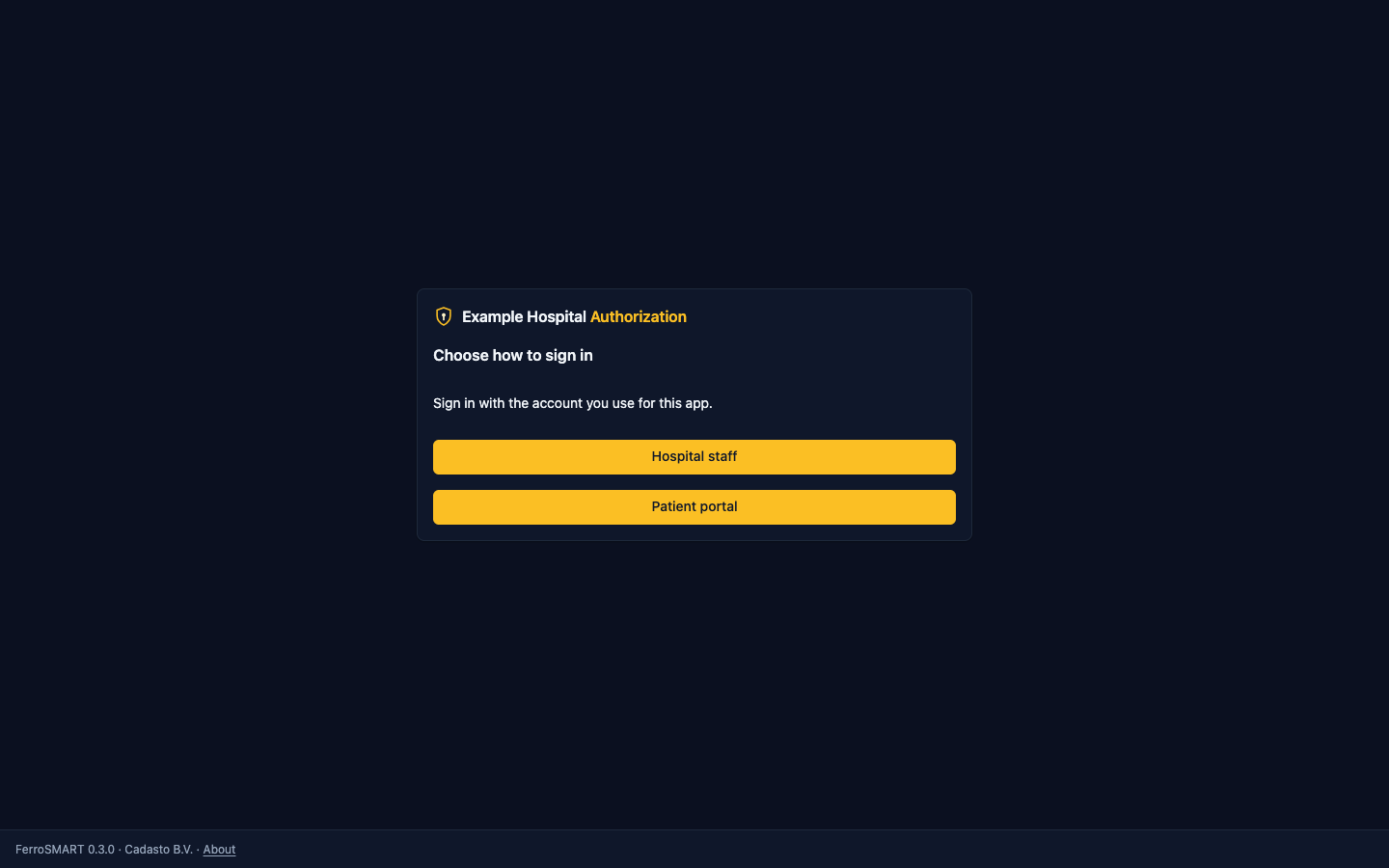
{issuer}/callback. When the app’s client may use more than one provider (itsupstreams, or every provider when it names none), the person first chooses one at{issuer}/login. - Pick the patient. When the app asks for
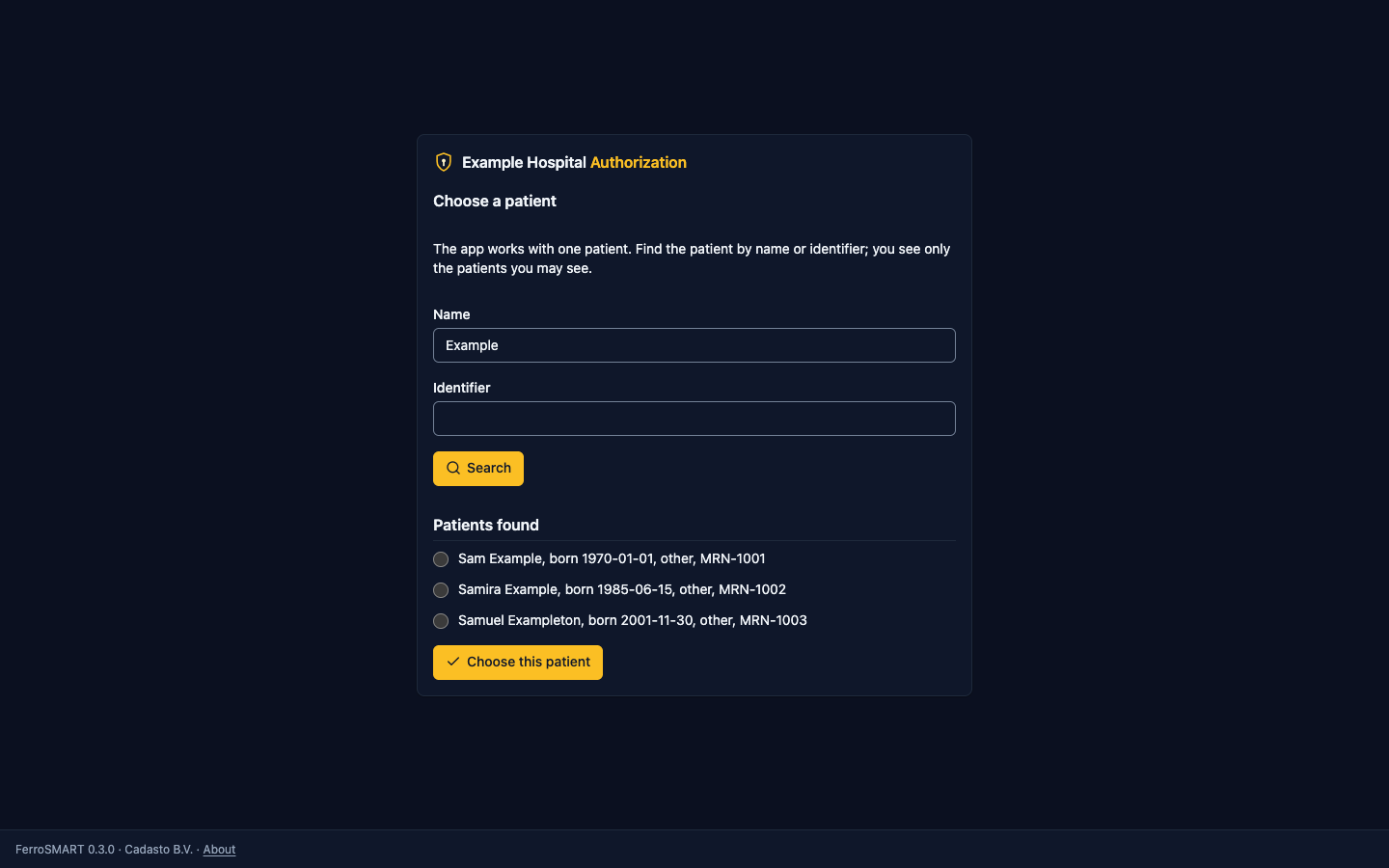
launch/patientand the server can be searched, FerroSMART shows its patient picker. A standalone app that asks apatient/scope withoutlaunch/patientis treated as asking it, and the grantedscopesays so. A patient whosefhirUsernames their ownPatientat that server (or at the FHIR server paired with the openEHR server asked) sees no picker: their own record, read again as them, is the context, and they get the app’spatient/scopes without a role at the identity provider. At a FHIR server the person searches by name or identifier (GET [base]/Patient); at an openEHR server whose[[ferrosmart.resource]]names asubject_namespace, the person enters the patient’s identifier and FerroSMART looks the EHR up (GET [base]/ehr?subject_id=…&subject_namespace=…). At an openEHR server paired with its platform’s FHIR server (fhir_base), the person searches the FHIR server instead, and FerroSMART looks the chosen patient’s EHR up by the identifiersubject_systemnames, so the context carries bothpatientandehrId. At an openEHR server that lists purposes of use ([[ferrosmart.resource.purpose]]), a professional chooses one on the picker page, and the lookups send it in the server’s purpose header. The search runs as the person, with a token of their own for that one server that lives 30 seconds and is revoked after the request, so the server’s rules decide which patients they see. The chosen patient is read again as them before it enters the context. When the app also asks forlaunch/encounterat a FHIR server, the picker then lists that patient’s encounters (GET [base]/Encounter?patient=…, as the person, with the scopeuser/Encounter.rs); the person chooses one or goes on without, and the chosen encounter is read again and must belong to the patient. - Consent. The person approves the scopes on the consent page (clients, roles and consent).
- The code. FerroSMART redirects to the app with
code, thestateas sent, andiss(RFC 9207). The code lives 60 seconds and is single use; a second use revokes everything the first one issued. - The token. The app posts to
{issuer}/tokenwithgrant_type=authorization_code, thecode, the sameredirect_uriand thecode_verifier, a public client with itsclient_id, a confidential one with its client assertion.
The patient picker, with a search and its results. Dark theme.
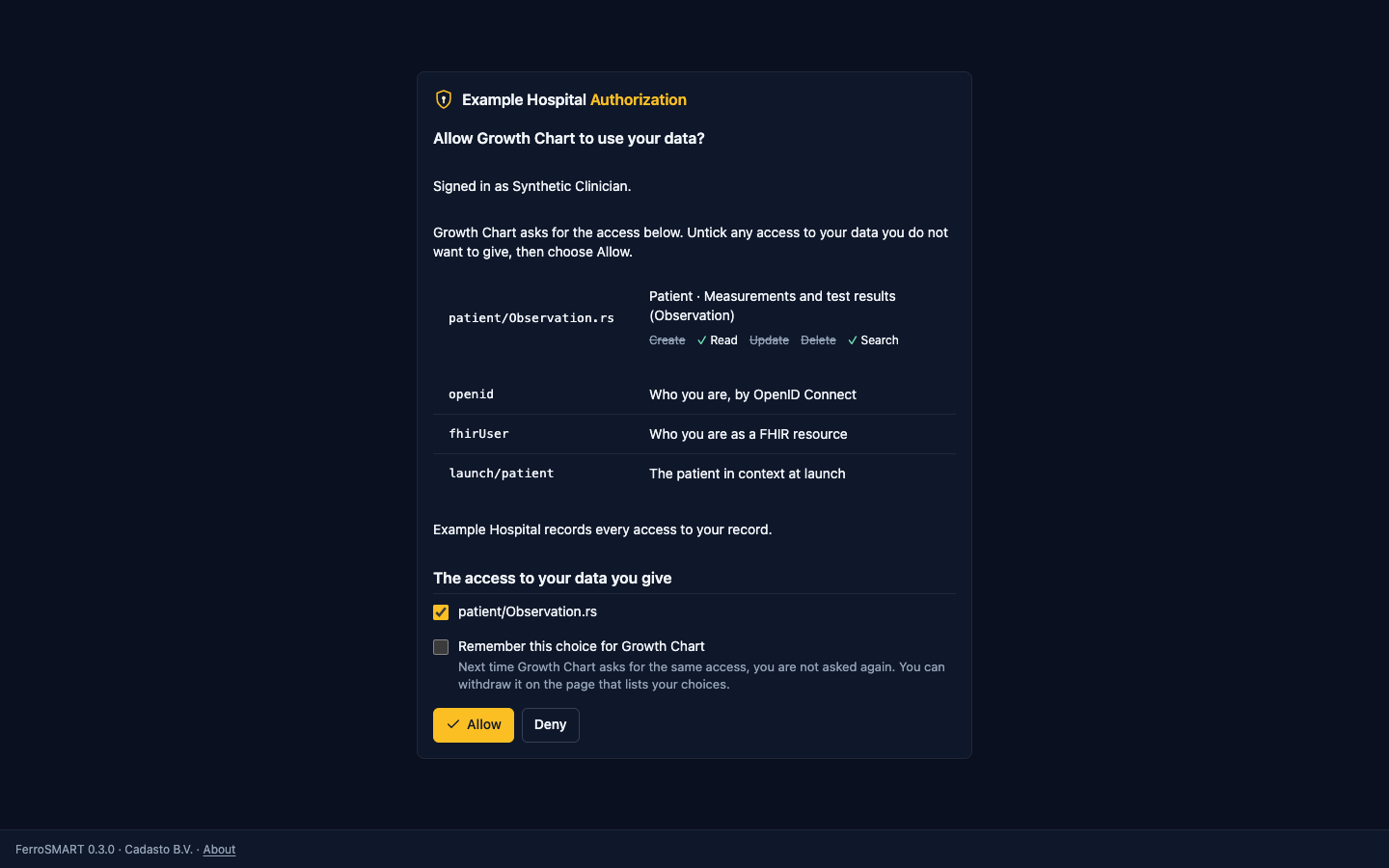
The consent page of an app that reads one patient’s record. Dark theme.
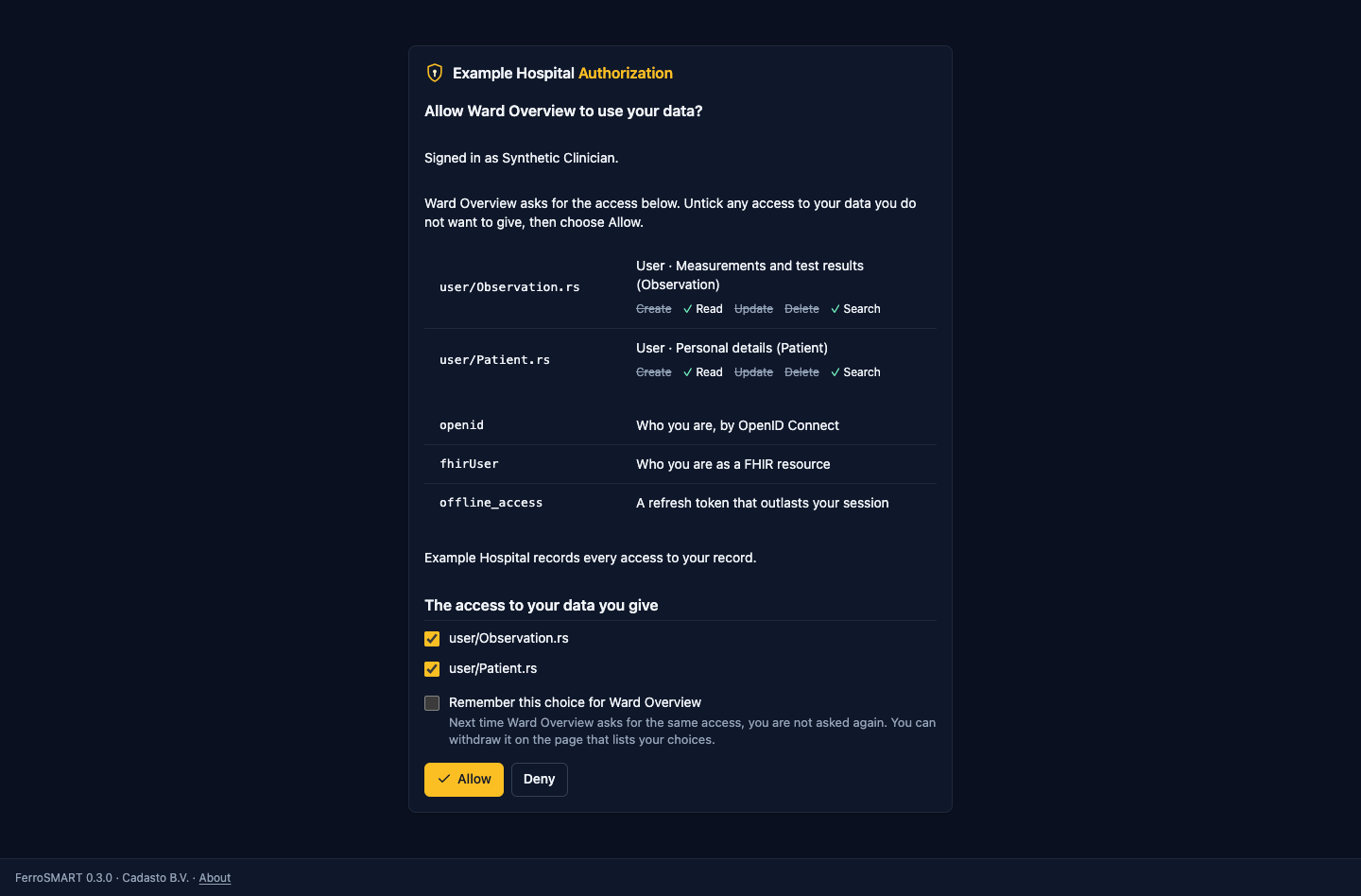
The consent page of an app a clinician uses across patients. Dark theme.
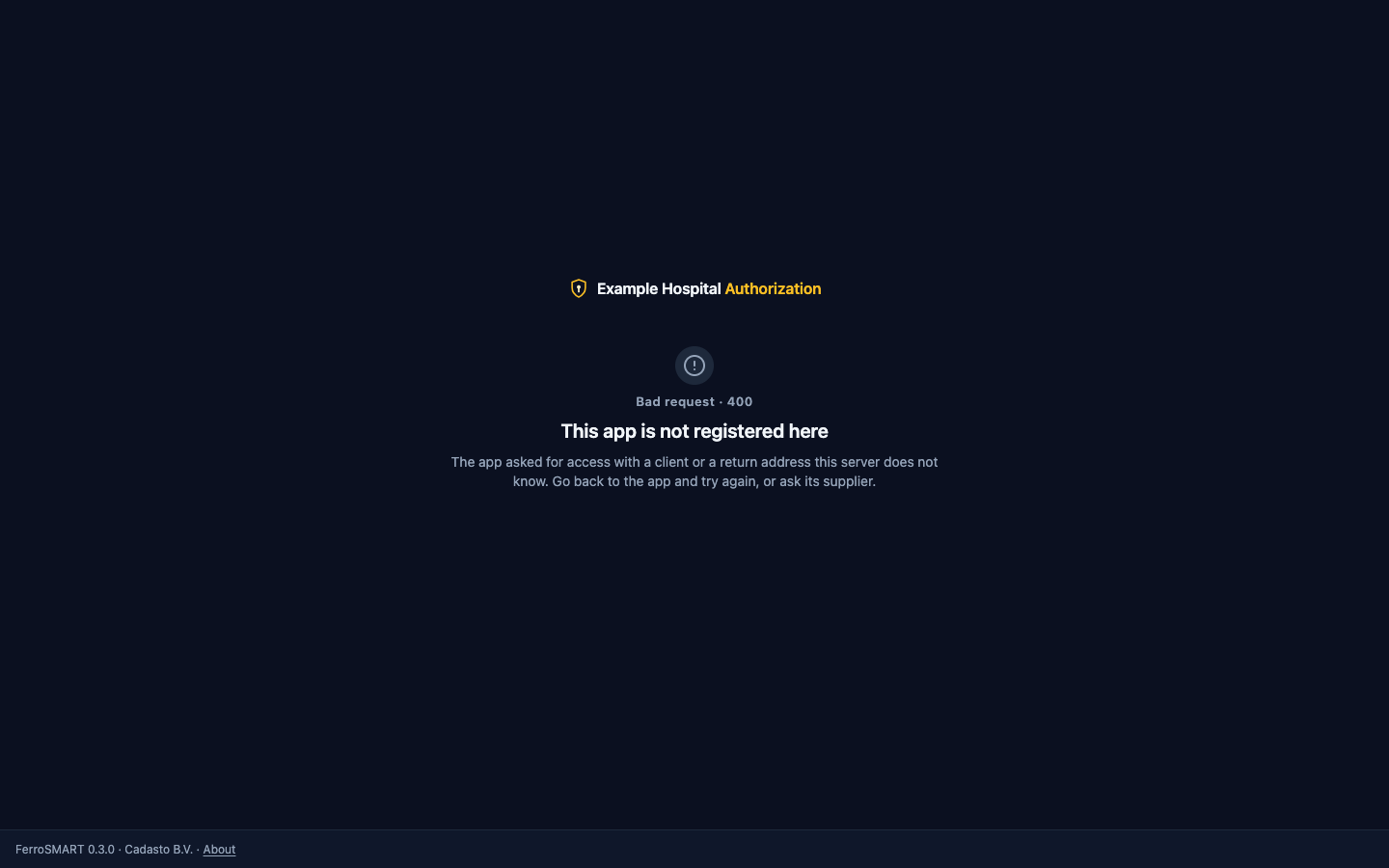
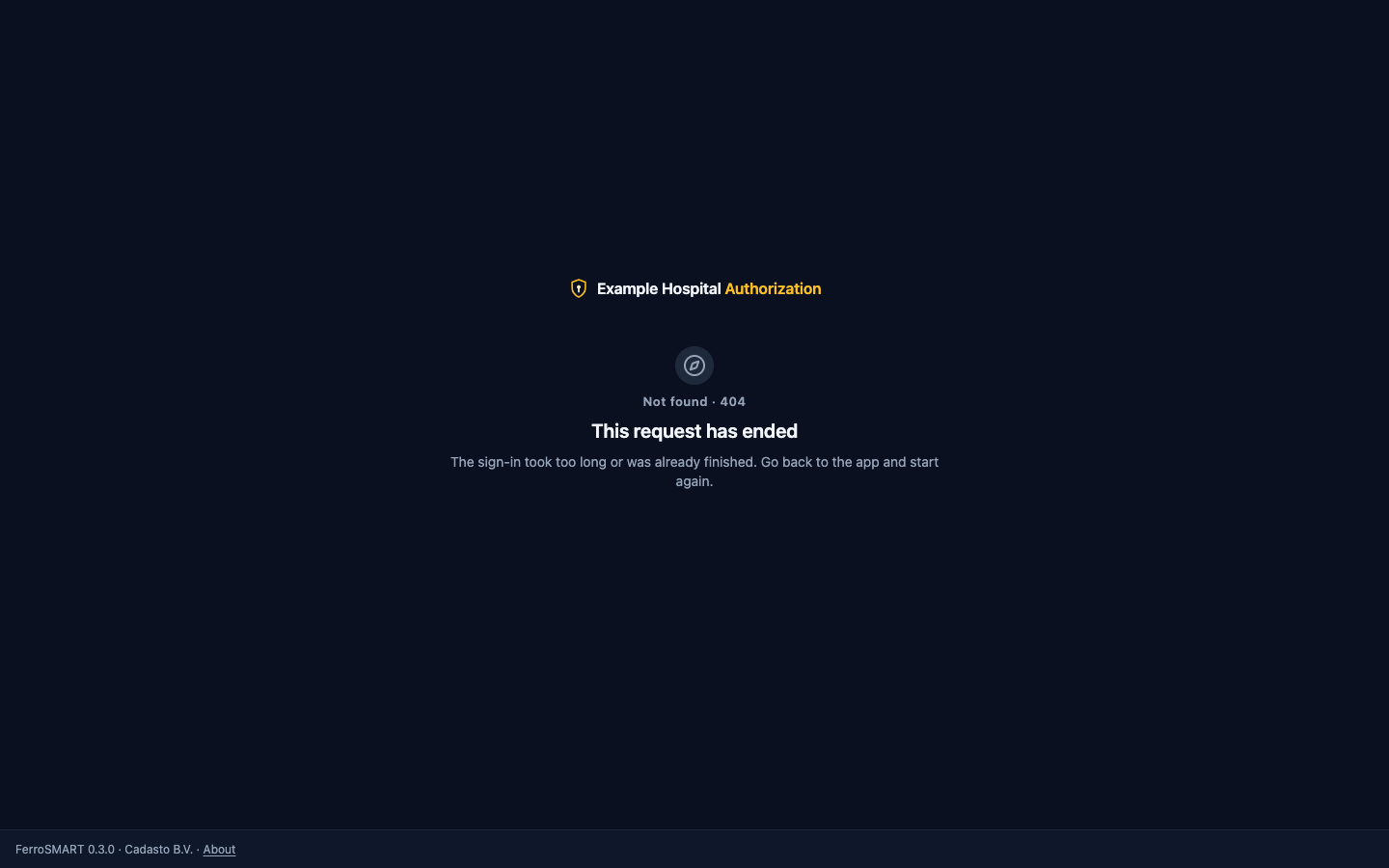
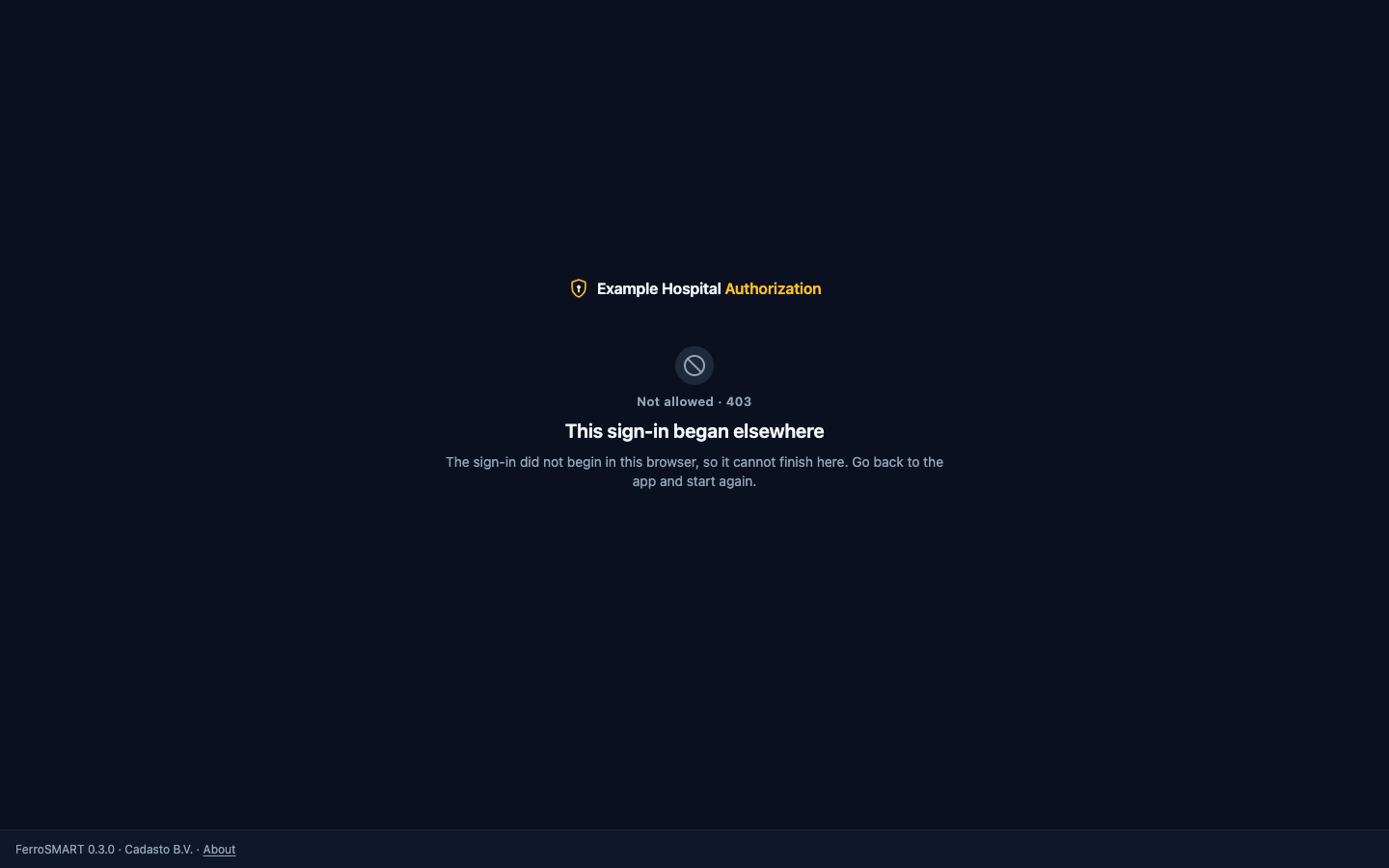
When a request cannot go on, FerroSMART tells the person on a page of its own and never redirects to an address it has not checked.
A request from an app nobody registered. Dark theme.
The consent page reached after the request lapsed. Dark theme.
A login that came back to a browser that did not begin it. Dark theme.
The token response carries access_token, token_type: Bearer,
expires_in, the granted scope, an id_token when openid was granted,
a refresh_token when a refresh scope was, and the launch context:
patient (or ehrId at an openEHR server), encounter, fhirContext,
need_patient_banner, intent and tenant as the launch set them, and
smart_style_url when the deployment configures one. Every token response
carries Cache-Control: no-store and Pragma: no-cache. A browser app’s
token request from one of its registered origins, the origins of its
redirect URIs, gets a CORS answer for that origin; any other origin gets
none.
The EHR launch
The EHR first gives FerroSMART the context and gets a launch value back,
then opens the app with iss and launch
(the EHR launch API). The app asks for the launch scope
and passes the value to /authorize; the rest is the standalone flow
without the picker, and the token response carries the context the EHR
registered.
What an app should expect
Three behaviours are fixed. Each one protects the person or the deployment, and an app works with it in the way described here.
“Remember this choice” is off by default, for the exact scopes asked.
The consent page asks again unless the person ticks “Remember this
choice”, and a remembered choice answers only a later request for the same
scopes or fewer; a request for more shows the page again. This keeps the
patient in control of what each app holds (SMART App Launch 2.2.0, Best
Practices). Ask for the same scopes on each launch, so a remembered choice
applies, and the person can disconnect the app on the management page
(management_endpoint).
Access tokens live five minutes. access_token_lifetime defaults to
five minutes, the same default Keycloak uses. An app that works longer than
that asks for online_access, a refresh token that lives while the person’s
login at the identity provider does, or offline_access, one that outlives
it, and refreshes before the token expires (SMART App Launch 2.2.0, Refresh
access token). The authorization server metadata lists refresh_token in
grant_types_supported (RFC 8414 §2), so a client that reads it knows the
grant is served. A rotated refresh token presented again within ten seconds
by the same client gets the same answer, so a retry is safe.
FerroSMART’s pages refuse to be framed. Every page answers with
frame-ancestors 'none' and its cookie is SameSite=Lax, which keeps
another site from overlaying the consent page (clickjacking, RFC 9700
§4.16). Microsoft Entra ID’s sign-in refuses framing as well. An app that
runs inside an EHR’s iframe opens the authorization request in a new window
or tab, and that window returns to the app’s redirect URI as usual.
The tokens
An access token is an RFC 9068 JWT, typ at+jwt, signed RS256 with a
key published at {issuer}/jwks. It carries iss, sub, aud,
client_id, iat, exp, jti and scope, and the context the response
carried: patient, encounter, fhirUser, and ehrId at an openEHR
server. Its aud is the one base the request named. It lives
access_token_lifetime, five minutes by default.
A person’s sub is pairwise: derived from the identity provider’s issuer
and sub, so two providers never collide and the provider’s identifier
never reaches a resource server. The ID Token, signed RS256, carries
iss, sub, aud, exp, iat, nonce when the app sent one,
auth_time, and fhirUser when fhirUser was granted. When the client’s
ceiling lists profile or email and the app asks for them, the ID Token
also carries name and preferred_username (profile) and email and
email_verified (email) as the identity provider sent them, so a
standard OpenID Connect library can show who is signed in. The sub
stays pairwise.
Backend Services
A system with no person uses the client credentials grant with a client assertion (SMART App Launch 2.2.0, Backend Services):
POST /token HTTP/1.1
Host: smart.example.org
Content-Type: application/x-www-form-urlencoded

grant_type=client_credentials
&scope=system%2FObservation.rs
&client_assertion_type=urn%3Aietf%3Aparams%3Aoauth%3Aclient-assertion-type%3Ajwt-bearer
&client_assertion=eyJ...
&resource=https%3A%2F%2Fehr.example.org%2Ffhir
resource names the server (RFC 8707); it may be left out when FerroSMART
serves one server alone, and FerroSMART’s own issuer is a resource too, for
the introspection and audit endpoints. The granted scope is the request
within the client’s ceiling, and the response has no refresh token. The
token’s sub is the client id.
Refresh, introspection and revocation
Refresh. A refresh token comes with offline_access or
online_access granted. grant_type=refresh_token with the token, and a
scope equal to the grant’s or narrower, returns a new access token and a
new refresh token: FerroSMART rotates every client’s refresh token on each
use. A rotated token presented again revokes the grant with every token
under it, except within 10 seconds of its rotation: the same client
presenting it again then gets the same new refresh token and a fresh access
token, so a retry after a lost response, or two tabs or two backend
instances refreshing at once, keeps the grant. A repeat after the window,
by another client, or once the new refresh token was used, is a replay. An offline_access token lapses after
refresh_idle unused; an online_access token after online_idle, or when
the person’s login at the identity provider ends through back-channel or
front-channel logout, or at FerroSMART’s end-session endpoint.
Logout. An app sends the person to end_session_endpoint
({issuer}/logout, OpenID Connect RP-Initiated Logout 1.0) with the ID
Token FerroSMART gave it as id_token_hint, and optionally a
post_logout_redirect_uri the client registered under
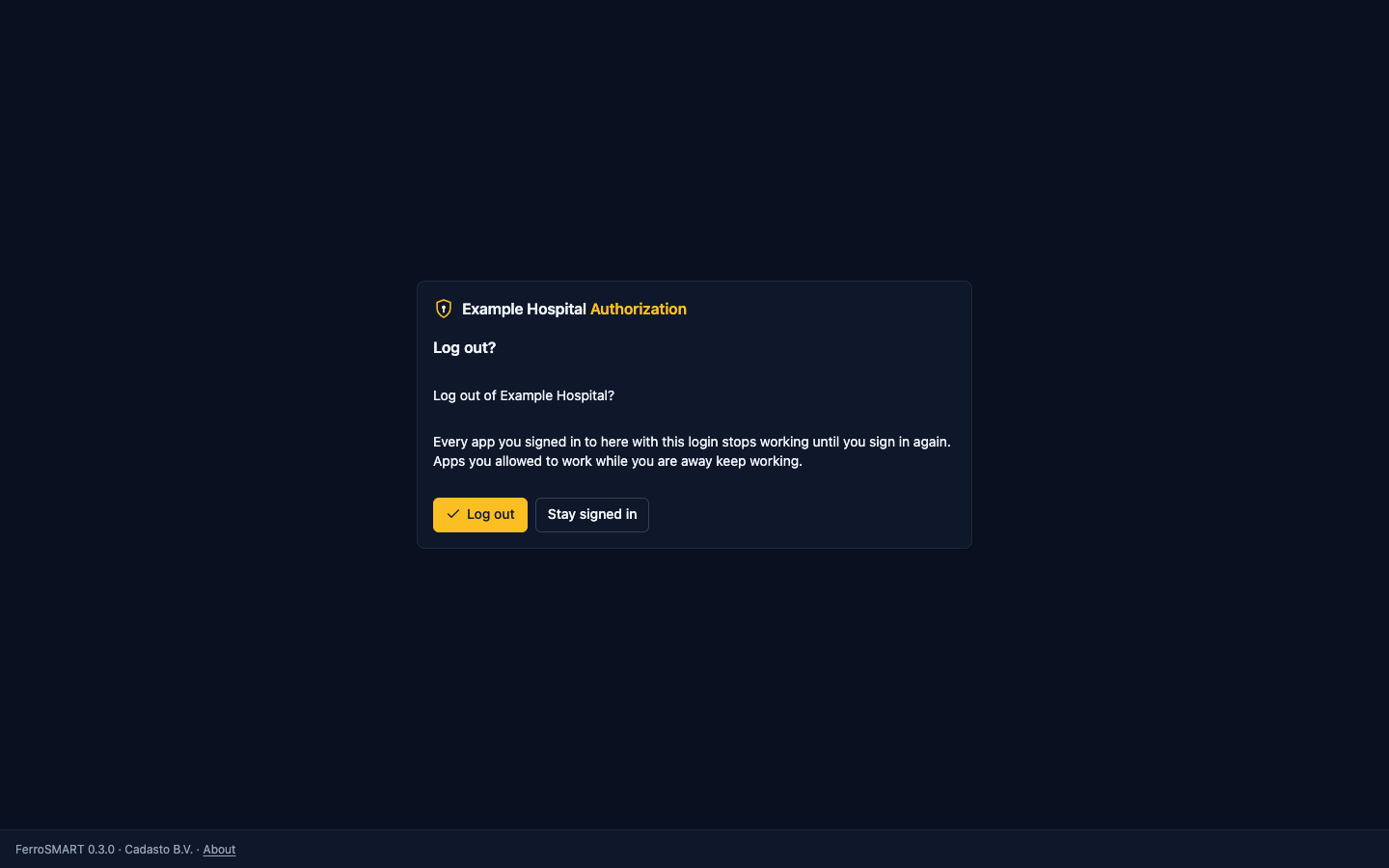
post_logout_redirect_uris and a state. FerroSMART asks the person to
confirm, ends their online_access grants (an offline_access grant
lives on), and sends the browser to the identity provider’s own logout
when it has one. The browser then comes back to the app’s
post_logout_redirect_uri with the state, or, when the app sent no
id_token_hint, to FerroSMART’s own logged-out page. A hint FerroSMART did
not issue, a client_id that is not the hint’s audience, or a redirect URI
the client did not register is a page and no redirect.
The end-session endpoint’s confirmation. Dark theme.
The chooser of an app whose people log in at either of two providers. Dark theme.
Introspection. POST {issuer}/introspect (RFC 7662) answers for any
token FerroSMART issued. The caller is a confidential client that
authenticates as at the token endpoint, by its private_key_jwt assertion
or its client secret (HTTP Basic or the form), or presents a bearer token
FerroSMART issued for its own issuer; either way it holds
system/introspect in its ceiling. A gateway that introspects with
client_secret_basic, such as Apache APISIX, registers as a confidential
symmetric client. A public client cannot introspect. An
active token’s answer carries active: true, scope, client_id, exp,
the launch context of the original response, and iss and sub of an ID
Token that was issued; anything else answers {"active": false} alone.
Revocation. POST {issuer}/revoke (RFC 7009) takes a token the calling
client holds: a confidential client authenticates, a public client sends
its client_id. Revoking a refresh token revokes its grant with every token
under it; revoking an access token revokes that token. An unknown token
answers 200; another client’s token is refused with
unauthorized_client.